

Top 10 CRM options for interior design firms
Compare CRM and practice tools for interior designers—owner relationships, vendor networks, and pre-RFP pursuits vs time and billing software.
- CRM
- Interior design
- Business development
- Pre-RFP
- Market intelligence
By George Valdes, co-founder at Toolblocks.
Interior design firms win work through owners, developers, architects, and repeat collaborators—often long before a formal RFP or fee proposal. When you search for the best CRM for interior designers, top results skew toward FF&E procurement—Agiled’s interior CRM list, Plutio, Deelo’s 2026 platform compare—and Houzz Pro / Studio Designer ops, not owner and architect pursuit.
That is only half the job. If your pain is purchase orders and trade pricing, start with vertical design-ops tools. If your pain is repeat commissions, architect referrals, and post-event follow-up, this guide compares named CRM and pursuit tools—Monograph, Deltek, HubSpot, Salesforce, and others—plus where pursuit intelligence fits when relationships and follow-through are the bottleneck.
Related in this series: Architecture firms · Lighting design · Pre-RFP BD
What “CRM” means for interior design
| Bucket | What it optimizes | Examples |
|---|---|---|
| Financial visibility | Time, invoicing, project budgets | Monograph, BQE CORE, Harvest |
| Pipeline CRM | Deal stages, marketing email | HubSpot, Salesforce, Pipedrive |
| Pursuit intelligence | Owners, vendors, signals, prep, follow-up | Toolblocks |
Package deadlines and FF&E coordination live in project tools. Winning the next commission lives in conversations, introductions, and showing up when nothing is official yet—see pre-RFP BD for AEC.
How we evaluated
We prioritized tools that help interior design BD and marketing teams:
- Track owners, developers, architects, and vendors in one relationship view
- Surface reasons to re-engage (portfolio updates, firm moves, project news)
- Shorten meeting and presentation prep with sourced context
- Orchestrate post-event and post-intro follow-up without heavy data entry
- Support prospect and market research with evidence for review
- Complement—not replace—PM, invoicing, or enterprise ERP
Scoring did not center on full practice-management depth alone.
Quick picks
Best for financial visibility: Monograph or BQE CORE for studios that need time, billing, and project economics in one place.
Best for generic pipeline: HubSpot when marketing runs nurture campaigns and needs a familiar CRM.
Best for pre-RFP pursuit intelligence: Toolblocks for owner/architect relationships, signals, prep, and follow-through—built for AEC-style BD, including interior design.
How to choose CRM for an interior design firm
-
Separate procurement from pursuit. Heavy FF&E and vendor PO volume → evaluate Houzz Pro, Studio Designer, or Design Manager first (see Tools we did not include below). Owner- and architect-led pipeline → pursuit intelligence and pipeline CRM below.
-
Map your win path. Owner-direct residential, developer-led multifamily, and architect-of-record referrals need different fields—not one generic “deal” object.
-
Size the team. Under 10 people, HoneyBook/Dubsado often cover intake; at 10+ with shared BD, you need a system both marketing and principals will actually open weekly.
-
Stack honestly. Common pattern: Harvest or Monograph for time/billing + HubSpot for nurture + Toolblocks for pursuit prep—or Toolblocks alone when BD is relationship-first.
| Studio type | Primary pain | Start with | Add for pre-RFP BD |
|---|---|---|---|
| Boutique residential, architect-referred | Referral follow-up | Monograph or Harvest | Toolblocks |
| Procurement-heavy, 25+ POs/project | Spec and PO chaos | Houzz Pro / Studio Designer | Toolblocks or HubSpot for top-of-funnel owners |
| Marketing-led inbound | Leads and email | HubSpot | Toolblocks for principal meeting prep |
When Houzz Pro or Studio Designer is enough—and when it is not
Enough when your team lives in spec packages, POs, trade pricing, and client portals—the core job to win is operational execution on a signed commission, not filling a cold pipeline. Houzz Pro (Ivy) and Studio Designer are category leaders for that motion; Agiled’s Houzz Pro comparison is honest about mood boards and sourcing vs CRM depth.
Not enough when growth depends on architect referrals, developer repeat work, and showroom or trade-event follow-through that never becomes a PO in those systems. You still need a relationship graph, last touch, and next action for owners and architects—often in HubSpot, spreadsheets, or pursuit intelligence (Toolblocks)—while keeping Houzz Pro or Studio Designer for delivery.
A weekly BD workflow for interior studios
- After every architect intro or showroom event: one owner record, last touch, next action within 48 hours.
- Before client presentations: one-page brief—portfolio hooks, open threads, competitor context—not a folder search.
- Monthly: prune pursuits with no activity in 90 days unless a signal (permit, groundbreaking, designer hire) revives them.
The list
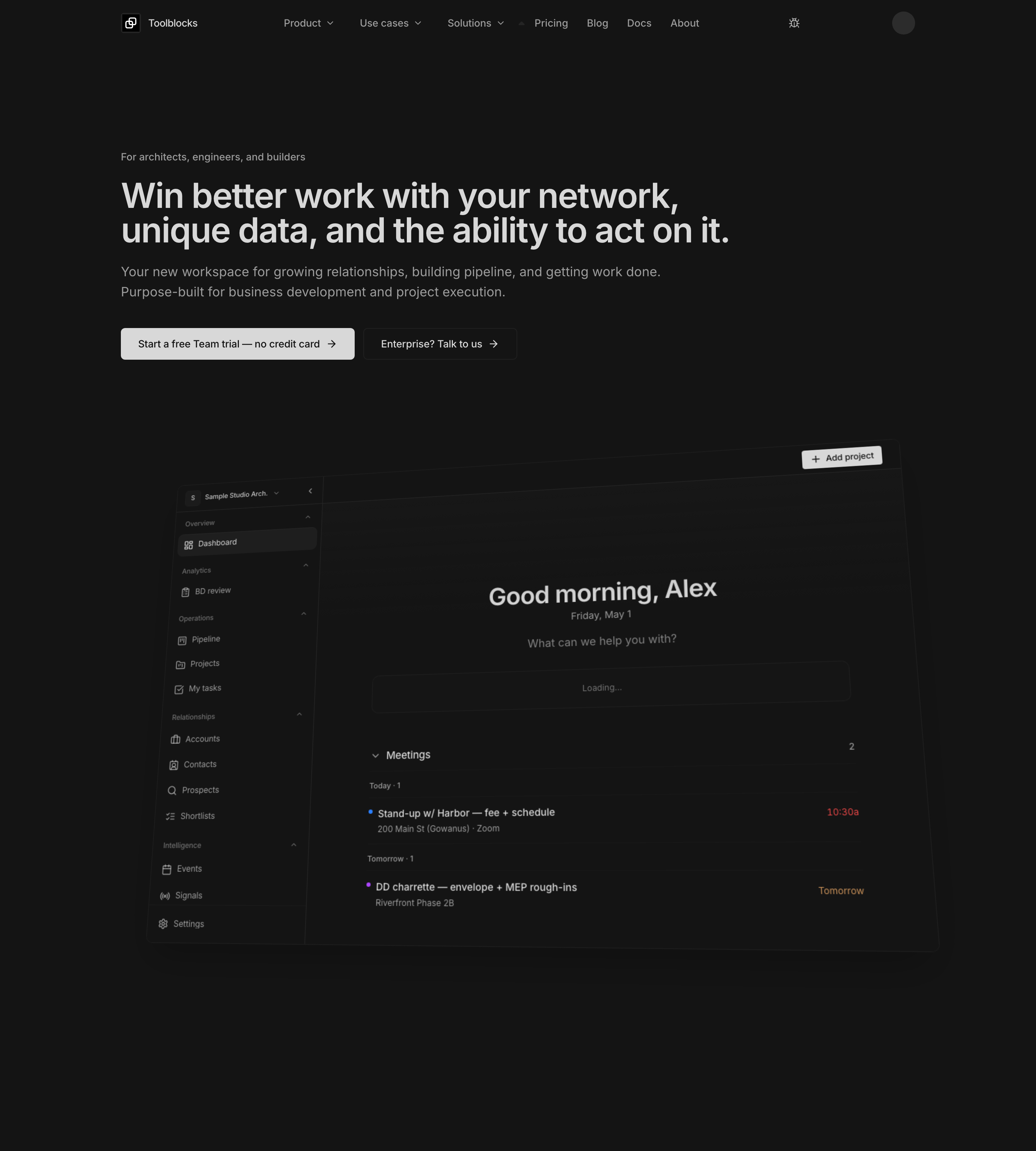
1. Toolblocks — best for owner and collaborator pursuit
Best for: Interior design firms that need a shared picture of who matters, why to reach out now, and what to do after salons, trade events, or architect intros.
- Relationship-centered contacts and pursuits, not a passive opportunity spreadsheet.
- Meeting prep and account research with sources for professional review.
- Fits seller-doer principals and small BD/marketing teams once event follow-through and next actions need to be shared, not held in one person’s inbox.
- Limitation: Not native invoicing, time tracking, or full PM; complements your billing stack.
Interior design fit: Strong when repeat work flows through architects and developers and you cannot afford dropped follow-up after install photos or showroom events.
Interior design · Seller-doers · Business development · What is Toolblocks? · Pricing
2. HubSpot — best for marketing nurture and lead capture
Best for: Studios investing in content, email lists, and staged pipelines for inbound interest.
- Workflows and forms for marketing-led leads; HubSpot offers free tools, and its standalone Smart CRM paid editions currently start at $20/seat/month—see HubSpot pricing.
- Limitation: Weak for “who is our path into this developer?” without custom objects and discipline.
Interior design fit: Marketing owns the website and newsletter; principals still need pursuit context elsewhere.
3. Monograph — best for design-studio operations
Best for: Firms that want architecture-adjacent PM—time, projects, invoicing—for a growing studio.
- Monograph’s public pricing page uses a firm-size calculator rather than a simple seat card; for smaller and mid-size firms, pricing commonly lands in the roughly $45-$60 per employee/month range, depending on employee count and billing selection—see Monograph pricing.
- Limitation: Pre-RFP owner and architect relationship work stays outside the product for most teams.
Interior design fit: When delivery and billing discipline matter more than pipeline intelligence.
4. Salesforce — best for structured BD at scale
Best for: Larger interiors groups with CRM admin and formal account plans.
- Reporting and territory models for multi-office firms.
- Many teams still experience Salesforce as the place they are asked to enter data after the fact, not the place they actually prep for owner and architect conversations.
- Limitation: Implementation cost and hygiene; rare for boutique studios without BD ops.
Interior design fit: National brands with dedicated capture teams—not typical 15-person studios.
5. Deltek / Cosential — best for AEC-aligned marketing CRM
Best for: Pursuit teams already in the Deltek ecosystem managing proposals and marketing pursuits.
- Cosential brings AEC marketing CRM patterns under Deltek.
- Limitation: Heavier marketing-ops motion than a weekly principal prep rhythm.
Interior design fit: Firms paired with AE partners on large institutional work and formal pursuits.
6. BQE CORE — best for billing and PSA workflows
Best for: Interiors practices that bill like professional services firms—time, expenses, AR.
- Strong billing story; BQE does not publish a flat public entry price and says pricing varies by modules and user count—see BQE pricing overview.
- Limitation: BD is not the product center of gravity.
Interior design fit: When margin leaks on billing lag, not on contact management.
7. Pipedrive — best for lightweight pipeline
Best for: One BD lead tracking a handful of pursuits with stages and tasks.
- Simple UI; Pipedrive’s pricing page currently lists Lite from US$14 per seat/month billed annually—see Pipedrive pricing.
- Limitation: No built-in AEC signals, event strategy, or sourced research briefs.
Interior design fit: Temporary CRM until pursuit volume justifies a vertical layer.
8. Zoho CRM — best for budget pipeline tracking
Best for: Cost-conscious teams that will maintain records weekly.
- CRM plus optional marketing apps; verify Zoho pricing.
- Limitation: Customization burden for owner/architect/vendor graphs.
Interior design fit: Early-stage studio formalizing outreach for the first time.
9. Harvest — best for time tracking with light CRM
Best for: Studios that primarily need timesheets and invoices with basic client tracking.
- Known for simple time tracking; plans on Harvest’s pricing page.
- Limitation: Not pursuit intelligence; CRM features are peripheral.
Interior design fit: Freelance-heavy teams billing hourly before they invest in BD systems.
10. Airtable / spreadsheets — best for DIY (until they break)
Best for: Very small teams with disciplined manual updates.
- Flexible bases for vendor lists and pursuit tabs.
- Limitation: No signals, no prep automation, ownership drifts when projects peak.
Interior design fit: Works until three people need the same owner context the night before a presentation.
Comparison at a glance
| Tool | Financial visibility | BD / pre-RFP | Typical firm size | Pricing (June 2026) |
|---|---|---|---|---|
| Toolblocks | Low (by design) | High | Shared BD/marketing rhythm | Pricing |
| HubSpot | Low | Medium | Marketing-led | Free tools; Smart CRM Starter from $20/seat/month |
| Monograph | High | Low | Growing studios | Roughly $45-$60 per employee/month for many small-mid firms |
| Salesforce | Low | Medium | Enterprise interiors | Free Suite $0; Starter Suite $25/user/month |
| Deltek / Cosential | Medium–high | Medium | Marketing BD | Deltek quote |
| BQE CORE | High | Low | PSA-minded | Quote-based |
| Pipedrive | Low | Low–medium | Small BD | Lite from US$14/seat/month billed annually |
| Zoho CRM | Low | Low–medium | Budget | Standard from $14/user/month annually |
| Harvest | Medium | Low | Small | Teams from $9/seat/month billed annually |
| Airtable | Low | Low (manual) | Micro | Team from $20/user/month billed annually |
Pricing verified against vendor-owned pricing pages on June 3, 2026. Vendors can change pricing after publish.
Tools we did not include for interior design
| Tool | Role | Why not top 10 here |
|---|---|---|
| Houzz Pro (Ivy) | Design ops, sourcing, 3D | Best for procurement-heavy studios—not the same as CRM for owner pursuit |
| Studio Designer / Design Manager | FF&E accounting | Industry standard for spec/billing; not pre-RFP relationship intelligence |
| HoneyBook / Dubsado | Intake and contracts | Strong for solos; breaks when 10+ people share owner context |
| Plutio / Agiled | All-in-one SMB | Workflow + invoicing; weak architect/developer graph out of the box |
| Deelo platform compare | Operations stack | Mydoma/Houzz/Studio Designer—helpful for software shopping, not pursuit BD |
We still recommend them when your search intent is operations, not winning the next commission early.
Common failure modes (and how to fix them)
Treating every architect intro as “handled” in email.
Fix: Log the firm, last touch, and next step where marketing and principals both see it.
Vendor rolodex with no pursuit link.
Fix: Tie key vendors and reps to active pursuits so FF&E conversations support the deal, not just the package.
Presentation prep from scratch.
Fix: Maintain a one-page owner brief—portfolio hooks, past work, open threads—updated when news hits.
Marketing CRM without principal adoption.
Fix: Pick a tool the seller-doer will open weekly; otherwise HubSpot becomes a newsletter platform only.
Confusing install photos with BD.
Fix: Celebrate delivery on social, but keep a separate pursuit queue for next commissions.
FAQ
What CRM do interior design firms actually use?
Often a mix: Monograph or Harvest for time and billing, HubSpot for marketing, and spreadsheets for owners and architects—until pursuit pain justifies Toolblocks or Cosential.
How is interior design BD different from architecture BD?
Shorter cycles with owners and developers, heavy architect and GC referrals, and vendor ecosystems around each pursuit. Signals include portfolio launches, showroom events, and package milestones—not only public RFPs.
Do we need CRM if we use QuickBooks and Excel?
You need a relationship system, not necessarily a generic CRM. QuickBooks will not tell you why to call an owner this week or what you discussed at the last design fair.
Can Toolblocks replace HubSpot?
Sometimes firms use Toolblocks for pursuit relationships and keep HubSpot for marketing automation—or use Toolblocks alone when BD is relationship-first, not inbound-volume-first.
How do interior firms save time on competitive intelligence?
Use sourced research briefs on targets and markets—competitor moves, past collaborators, public project news—so principals review facts instead of rebuilding Google searches. Toolblocks is built for that review-first workflow.
Where does Toolblocks fit for interior design?
Pursuit intelligence for interior design—contacts, signals, prep, follow-through—alongside your billing tool. See Win work overview.
Houzz Pro vs HubSpot vs Toolblocks—which do I need?
Houzz Pro for design delivery and sourcing. HubSpot for marketing automation and inbound leads. Toolblocks for shared pursuit context, meeting prep, and follow-through on architect and owner relationships. Many firms need two of three—not one tool for everything.
Do interior designers need a CRM if they use Studio Designer?
Studio Designer runs money and specs; it does not tell you why to call an owner this month or what you promised an architect at the last trade event.
What is the best CRM for a small interior design studio?
Under 10 people: disciplined spreadsheets or HoneyBook/Dubsado for intake. At 10+ with coordinated BD: pursuit intelligence plus optional HubSpot—see architecture CRM list for the same three-bucket frame.
How do interior firms track architect referrals?
Use a shared contact graph (firm, role, last touch, linked pursuit)—not a tab in a personal inbox. Tag referral source on every active pursuit so marketing can see which relationships produce work.
Where to go next
Keep your billing stack. Add discipline for winning the next commission before it is a fee proposal: pre-RFP BD, interior design, pricing.
About the author
George Valdes is the co-founder of Toolblocks. He previously led product as Head of Product at Integrated Projects (AI-powered Scan-to-BIM) and was Head of Marketing at Monograph. He co-founded Architechie NYC and serves as a board member for the 1735 NY Ave Investments Fund at the American Institute of Architects (AIA). He is based in St. Petersburg, Florida, and is bilingual in English and Spanish.