

Best CRM for Architects: 10 options for architecture firms
Compare the best CRM for architects and architecture firms, including Monograph, Deltek, HubSpot, Salesforce, and Toolblocks—plus which tools fit pre-RFP BD vs PM and billing.
- CRM
- Architecture
- Business development
- Pre-RFP
- Pursuit intelligence
By George Valdes, co-founder at Toolblocks.
This guide is written for a specific buyer: architecture firms where business development is already shared work, not one principal’s private spreadsheet. In practice, that usually means a firm with a seller-doer principal, a BD or marketing partner, a defined client profile, and enough active pursuits that follow-through can no longer live in memory.
If you are searching for the best CRM for architects, you are probably not asking for “more software.” You are asking a simpler question: how do we stop losing track of relationships, follow-up, and live pursuits without turning principals into CRM clerks?
Most “best CRM for architecture firms” posts blur together three different jobs:
- Running the firm’s money: time, WIP, budgets, invoicing
- Running a marketing pipeline: forms, nurture, stage reporting
- Winning work before the RFP: relationships, signals, meeting prep, follow-through
Those are related jobs. They are not the same purchase.
This guide names real products, shows who each one is actually for, and tells you when to stop shopping for CRM and buy a different category of tool instead. If your firm already has project financials covered, but important follow-up still lives in inboxes and memory, this is the guide you want.
If you are a solo or very small studio that mainly needs proposals, invoices, and light client tracking, this page will likely be more software than you need right now. If you are a 10+ person architecture firm where principals, BD, and marketing need one shared view of accounts, relationships, signals, and next actions, this is the right comparison.
Related in this series: Interior design · Civil engineering · Structural engineering · Construction / precon
Quick answer
If you only need the short version:
- Best for very small studios that mostly need operations: Monograph
- Best for enterprise AEC financial control: Deltek Vantagepoint / Ajera
- Best for marketing-led inbound and nurture: HubSpot
- Best for firms with CRM admin capacity and custom process: Salesforce
- Best for coordinated seller-doer and BD teams before the RFP: Toolblocks
If your real pain is timesheets, billing, or WIP, start with Monograph, BQE, or Deltek.
If your real pain is owner follow-up, repeat-client visibility, seller-doer prep, and “why now” outreach, a generic CRM alone will usually disappoint you.
If your real pain is coordinating principals, BD, and marketing around the same target accounts, skip generic “best CRM” advice and focus on tools that support shared pursuit context.
The real time problem behind architecture BD
This category only makes sense if you start with how time is actually spent inside an architecture firm.
For seller-doer principals
Seller-doers rarely lose pipeline because they do not care about BD. They lose pipeline because BD gets squeezed between delivery, internal management, and proposal deadlines.
Their time usually goes to:
- Meetings, lunches, events, and introductions
- Fast follow-up that is easy to delay until next week
- Rebuilding meeting context from old email threads, notes, and memory
- Reviewing proposals and fees after the relationship work is already done
- Project delivery, which always feels more urgent than CRM hygiene
What they struggle with:
- Remembering who to follow up with and why
- Turning a good conversation into a next step while context is still fresh
- Seeing which warm relationships are actually turning into work
- Keeping top-of-mind with the right owners, developers, and collaborators without living in the inbox
Pipeline impact:
- Warm opportunities cool off because no one follows up within 24-48 hours
- Important meetings start from scratch because prep lives in scattered notes
- The same few relationships get attention while other good accounts quietly decay
For dedicated BD and marketing leads
Dedicated BD people lose time differently. Their job turns into air traffic control: who knows whom, who owns the relationship, what happened last, what the next move is, and how to get principals to act before momentum dies.
Their time usually goes to:
- Building account plans and relationship maps
- Tracking which office, studio, or principal owns a relationship
- Preparing principals for meetings and interviews
- Chasing follow-up after events, intros, and client touchpoints
- Cleaning and reconciling CRM data that nobody trusts
What they struggle with:
- Getting a clean picture of relationship warmth across the firm
- Knowing where to focus limited principal time
- Keeping account plans current without spending a week rebuilding them
- Proving which activity is helping pipeline and which activity is just administrative motion
Pipeline impact:
- Too much time goes to coordination and not enough to actual outreach
- Firms cannot scale relationship strategy across offices or markets
- BD becomes reporting-heavy instead of predictive
Why this matters for software choice
If you are only solving for pipeline fields, you are solving the wrong problem for both audiences.
- Seller-doers need less prep friction, less mental load, and better follow-through.
- Dedicated BD leads need shared visibility, relationship mapping, and a way to turn scattered activity into an actual pursuit system.
That is why architecture firms often keep one tool for project money and another layer for the work that happens before the RFP.
Three kinds of “CRM” in architecture
| Bucket | What it optimizes | Examples |
|---|---|---|
| Financial visibility | Time, WIP, budgets, invoicing, utilization | Monograph, BQE CORE, Deltek Ajera / Vantagepoint |
| Pipeline CRM | Deal stages, marketing automation, reporting | HubSpot, Salesforce, Cosential |
| Pursuit intelligence | Pre-RFP relationships, signals, prep, follow-through | Toolblocks |
None of these replace the others by default. Many firms run one tool for money and something lighter, or nothing at all, for business development until the cracks become obvious.
Who this guide is for
- Best fit: Architecture firms with active seller-doers, recurring target accounts, and at least one person who owns BD rhythm or marketing follow-through.
- Strong fit: Firms that already know their ideal client profile by market, sector, geography, or client type and want better account coverage, meeting prep, and next-action discipline.
- Also a fit: Firms trying to support both audiences at once: the principal who does not want more admin, and the BD lead who is tired of manually coordinating everybody else.
- Weak fit: Solo studios shopping mainly for invoices, proposals, or project operations.
- Wrong fit: Firms expecting one tool to replace PM, ERP, invoicing, CRM, capture, and research in a single purchase.
How we evaluated
We scored tools for business development and pre-RFP work for the buyer above, not primarily for billing:
- Contact and account graph (people, firms, history)
- Signals and “why now” for outreach
- Meeting prep and account briefs (with sources to verify)
- Follow-through rhythm (next actions, not just opportunity stages)
- Evidence-backed prospect and market research
- Adoption without a full-time CRM admin
- Path to sit in front of—or complement—Deltek, HubSpot, Salesforce, or spreadsheets
We did not rank tools mainly on native invoicing, timesheets, or enterprise WIP—that is a different buying decision.
Quick picks
Best for financial visibility: Monograph or Deltek Ajera/Vantagepoint, depending on firm size and ERP maturity.
Best for generic marketing and sales pipeline: HubSpot or Salesforce—with the expectation you will customize for AEC.
Best for pre-RFP pursuit intelligence: Toolblocks—relationships, signals, prep, and follow-through for architecture BD; complements your PM/ERP stack.
How to choose a CRM for your architecture firm
Use this order so you do not buy the wrong category of software.
-
Name the bottleneck first. If utilization, WIP, and invoicing are the pain, shortlist financial visibility tools (Monograph, BQE CORE, Deltek Ajera/Vantagepoint). If marketing needs email nurture and forms, shortlist pipeline CRM (HubSpot, Pipedrive). If principals rebuild pursuit context from email before every owner meeting, you need pursuit intelligence—often on top of whatever you already run.
-
Match firm size and BD maturity. Solo and micro studios (under 10 people) can run disciplined spreadsheets longer than SERP guides admit. The real break point is when BD, marketing, and principals all need the same pursuit context every week.
-
Test seller-doer adoption ruthlessly. The CRM your principal will not update after a lunch is the wrong CRM. Outlook-native pipelines (Unanet CRM) and lightweight pursuit layers (Toolblocks) tend to beat empty Salesforce shells.
-
Decide go/no-go depth. Federal and institutional pursuits often need Cosential-class marketing CRM and formal go/no-go. Boutique private-sector studios may only need a relationship graph, last touch, and next action until volume justifies Deltek.
-
Plan the stack, not the rip-and-replace. Keep Monograph or Deltek for money; add HubSpot for inbound if needed; add Toolblocks for pre-RFP prep and follow-through—see what Toolblocks is and pricing.
| If your firm looks like… | Start here | Add when pursuits hurt |
|---|---|---|
| 5-person studio, mostly repeat clients | Monograph or spreadsheets | Toolblocks or HubSpot when BD is no longer one person’s memory |
| 25-person firm, mixed private + public | Monograph or BQE + Cosential or HubSpot | Toolblocks for principal prep and signals |
| 100+ person, ERP-led | Deltek / Unanet | Toolblocks or TrebleHook layer for seller-doer rhythm |
The most important filter is not just size. It is coordination load. Once multiple people need the same account history, target list, meeting prep, and follow-up queue, the buying criteria change.
A weekly BD workflow that actually sticks
Competitor listicles rarely describe habits. Architecture firms that win pre-RFP work usually run a light weekly loop:
- Monday (15 min): Review pursuits with a next action in the next 14 days; drop or pause accounts with no signal and no relationship path.
- Wednesday (30 min): One sourced account or jurisdiction brief for an upcoming meeting—draft for review, not autopilot outreach.
- Friday (15 min): Log last touch on active targets; assign one follow-up per pursuit owner before the week goes dark.
Tools only work when this loop has an owner. In most firms, that is a BD lead, marketer, or principal who keeps the weekly pursuit rhythm alive instead of letting it disappear into delivery work.
The list
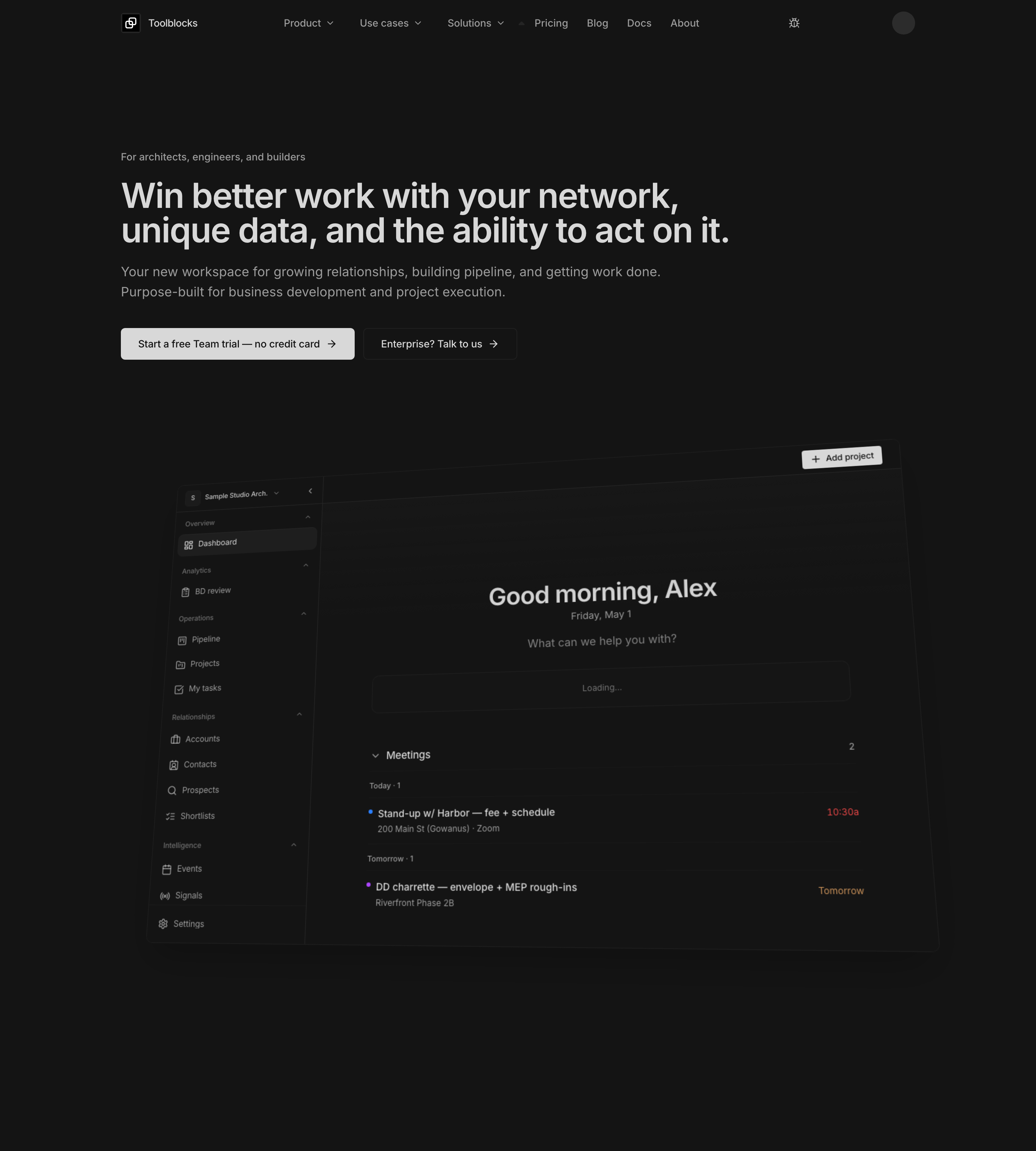
1. Toolblocks — best for pre-RFP business development
Best for: Architecture firms that need to win work before the RFP and already have a real coordination problem between principals, BD, and marketing.
- Contacts, pursuits, and research live in one shared workspace for the people driving growth.
- Signals and account context help answer “why reach out now?”
- LinkedIn helps anchor who the people are and how they connect to your network; email and calendar history help show recent relationship context, meeting cadence, and last touch before outreach.
- Meeting prep and prospect research produce drafts for review with sources where possible.
- Works best when your team already manages outreach through LinkedIn, email, and meetings and needs one place to turn those touchpoints into briefs, follow-ups, and shared account memory.
- Limitation: Not a replacement for Monograph or Deltek on time, WIP, or invoicing. Best when principals and BD/marketing already share a live pursuit pipeline weekly.
Architecture fit: Strong when your firm already has a clear ideal client profile, named target accounts, and a real need for shared pursuit context instead of rebuilding every brief from inbox search.
Learn more: Architecture · Seller-doers · Business development · What is Toolblocks? · Pricing
2. Monograph — best for studio operations and project financials
Best for: Architecture-first practice management—especially smaller studios where operational discipline matters more than multi-person pursuit coordination.
- Monograph’s public pricing page uses a firm-size calculator rather than a simple seat card; for smaller and mid-size firms, pricing commonly lands in the roughly $45-$60 per employee/month range, depending on employee count and billing selection—see Monograph pricing.
- Strong project and utilization visibility for principals who live in delivery.
- Limitation: BD and pre-RFP relationship work still tend to live in email, LinkedIn, and spreadsheets; it is not a pursuit-intelligence layer.
Architecture fit: Excellent when your primary pain is running the practice, not filling the pipeline upstream of proposals.
3. Deltek Vantagepoint / Ajera — best for enterprise AEC financial control
Best for: Larger architecture and AE firms that need ERP depth—WIP, resourcing, accounting integration, and portfolio reporting.
- Mature AEC footprint; Ajera often discussed for smaller AEC, Vantagepoint for enterprise.
- Limitation: Implementation and change management are heavy; pre-RFP seller-doer workflows often stay outside the ERP unless you invest in process and integrations.
Architecture fit: Right when finance and PMO standards matter more than a lightweight BD loop for a market leader.
4. Cosential (Deltek) — best for AEC marketing and pursuit CRM
Best for: Marketing-driven pursuits—proposal support, pursuit tracking, and CRM oriented to professional services BD teams.
- Familiar in AEC marketing circles; aligns with Deltek ecosystem.
- Limitation: Can feel like a marketing ops system rather than a daily seller-doer rhythm; still not a substitute for relationship signals and fast prep for principals.
Architecture fit: Teams with dedicated marketing/BD staff managing formal pursuits and collateral.
5. HubSpot — best for marketing automation and inbound
Best for: Firms investing in content, email nurture, and a generic deal pipeline—with someone on the team willing to own setup and hygiene.
- Free tier and familiar CRM objects; paid hubs scale with marketing and sales needs—see HubSpot pricing.
- Limitation: AEC relationship context (events, referrals, repeat collaborators) requires customization; weak out of the box for “who do we know at this developer?”
Architecture fit: When marketing owns lead capture and you will wire integrations to your PM stack manually.
6. Salesforce — best for mature sales operations
Best for: Firms with dedicated CRM admin and a defined sales process—not typical for architecture firms unless BD operations are already formal.
- Extremely flexible objects, reporting, and ecosystem.
- Many firms experience Salesforce as a data-entry system of record, not the place seller-doers actually prepare for meetings or decide who to call next.
- Limitation: High setup and hygiene cost; seller-doer principals rarely maintain it without a BD ops owner.
Architecture fit: Regional firms with centralized BD and IT support.
7. BQE CORE — best for time, billing, and PSA depth
Best for: Firms that want strong PSA workflows—time, expenses, billing, and accounting bridges—across disciplines.
- Deep billing and utilization feature set; BQE does not publish a flat public entry price and instead states that pricing varies by modules and user count—see BQE pricing overview.
- Limitation: Opportunity tracking exists, but the center of gravity is delivery economics, not pre-RFP relationship intelligence.
Architecture fit: Multi-discipline studios where billing discipline is the bottleneck more than pipeline creation.
8. Unanet — best for project-based ERP (especially gov-adjacent work)
Best for: Project accounting and compliance-heavy environments; common where public and institutional work dominates.
- Strong project cost and compliance story for larger orgs—pricing quote-based at unanet.com.
- Limitation: BD and capture often live in parallel tools; not a lightweight pursuit workspace for principals.
Architecture fit: Less common for pure private-sector boutique architecture, more relevant when your work rhymes with civil/govcon delivery models.
9. Pipedrive — best for simple deal tracking
Best for: A small BD function that only needs stages, activities, and a clean pipeline view on a budget.
- Fast to stand up; Pipedrive’s pricing page currently lists Lite from US$14 per seat/month billed annually—see Pipedrive pricing.
- Limitation: No AEC-specific relationship graph, signals, or sourced research briefs without bolting on other tools.
Architecture fit: Interim CRM when marketing is one person and pursuits are few.
10. Zoho CRM — best for cost-conscious pipeline tracking
Best for: Firms that want CRM objects and automation without Salesforce-scale cost.
- Broad Zoho suite; Zoho’s public USD comparison sheet currently lists Standard at $14/user/month billed annually or $20/user billed monthly—see Zoho CRM pricing.
- Limitation: Same AEC customization tax as HubSpot; easy to become a stale opportunity database.
Architecture fit: Backup option when budget is tight and someone will own data entry weekly.
Comparison at a glance
| Tool | Financial visibility | BD / pre-RFP | Typical firm size | Pricing (June 2026) |
|---|---|---|---|---|
| Toolblocks | Low (by design) | High | Shared BD/marketing rhythm | Pricing |
| Monograph | High | Low | 1–100+ architects | Roughly $45-$60 per employee/month for many small-mid firms |
| Deltek VP / Ajera | High | Medium (Cosential) | Mid–enterprise | Vendor quote |
| Cosential | Medium | Medium–high | Marketing-led AEC | Deltek quote |
| HubSpot | Low | Medium | Any | Free tools; Smart CRM Starter from $20/seat/month |
| Salesforce | Low | Medium | Mid–enterprise | Free Suite $0; Starter Suite $25/user/month |
| BQE CORE | High | Low | PSA-focused | Quote-based |
| Unanet | High | Low | Enterprise / govcon | Vendor quote |
| Pipedrive | Low | Low–medium | Small BD team | Lite from US$14/seat/month billed annually |
| Zoho CRM | Low | Low–medium | Budget-conscious | Standard from $14/user/month annually |
Pricing verified against vendor-owned pricing pages on June 3, 2026. Vendors can change pricing after publish.
Tools we did not include (and why)
Honest listicles admit category boundaries. We left these out of the top 10 because they are usually not what architects mean by “CRM for winning work”—even when they appear on other lists:
| Tool / category | Why it is not in our top 10 |
|---|---|
| Scoro, Accelo, Monday CRM | Strong PSA or generic work OS; AEC pursuit depth requires heavy configuration. |
| Archivinci, EngageBay | Large generic lists with G2-style ratings—we do not copy star scores; verify fit for your firm size. |
| Bonsai, Dubsado | Proposal/client workflow for solos—not relationship intelligence for 10+ person studios. |
| RFP aggregators | Find public bids; they do not replace referral networks or pre-RFP positioning. |
| Pure AI outreach tools | Violate trust positioning; Toolblocks drafts for review with sources. |
| Revit / BIM platforms | Delivery tools, not BD systems. |
If you are evaluating TrebleHook (Salesforce for AEC) or HSO AEC360 (Dynamics), treat them as enterprise pursuit layers in the same bucket as Cosential—compare on go/no-go, teaming, and implementation cost, not on time tracking.
Common failure modes (and how to fix them)
Reading general CRM advice when your real problem is shared pursuit coordination.
What’s happening: You buy for feature breadth instead of buyer fit.
Small fix: Start by asking whether multiple people need the same account context weekly. If yes, buy for coordination and prep, not just pipeline fields.
Buying Monograph or Deltek expecting it to run BD.
What’s happening: Project financials improve, but principals still rebuild pursuit context from email before every meeting.
Small fix: Keep PM/ERP for money; add a pursuit layer for contacts, signals, and prep—see why BD starts before the RFP.
Spreadsheet graveyard.
What’s happening: “Target list” grows without owners, last touch, or next step.
Small fix: Cap active accounts to what you can touch monthly; one owner per account; one next action with a date.
Generic CRM with no “why now.”
What’s happening: Opportunities have stages but outreach feels cold.
Small fix: Tie tasks to signals—leadership changes, portfolio moves, events—not just “follow up Q3.”
Seller-doer prep tax.
What’s happening: Principals spend 30–90 minutes before important meetings re-reading old threads.
Small fix: Living account briefs updated when something changes, not the night before the call.
Chasing enterprise CRM too early.
What’s happening: Salesforce implementation stalls; nobody maintains data.
Small fix: Keep Salesforce for stage governance and reporting if you need it, but let seller-doers work in a lighter pursuit layer for relationship context, prep, and follow-through.
FAQ
Do architects need a CRM if they already use Monograph?
You need something for winning work upstream of projects. Monograph is strong for studio operations and financial visibility; most firms still keep relationships, event follow-up, and pre-RFP prep elsewhere unless they add a pursuit-focused layer like Toolblocks or discipline Cosential/HubSpot with real process.
What is the best CRM for small architecture firms?
For 1–9 people, spreadsheets plus disciplined weekly BD often suffice for pipeline. For 10+ with coordinated BD/marketing, prioritize pre-RFP pursuit intelligence (Toolblocks) plus optional PM (Monograph) rather than a heavy ERP.
Deltek vs HubSpot for architecture business development?
Deltek (especially Cosential/Vantagepoint) fits formal pursuit reporting and enterprise marketing ops. HubSpot fits inbound and email nurture. Neither replaces relationship signals and fast, sourced meeting prep for seller-doer principals—many firms use Toolblocks in front of both.
How much time does meeting prep take without a system?
Seller-doers often report 30–90 minutes reconstructing context per important meeting. A shared account brief and signal feed can cut that to a short review—if someone maintains it weekly, not only at proposal time.
Can Toolblocks replace our CRM?
Usually no—and we do not position it as full practice management. Firms keep Deltek, HubSpot, Salesforce, or Airtable for contracts and reporting while using Toolblocks for contacts, signals, research, and follow-through. The cleaner positioning is: Salesforce as system of record, Toolblocks as the workspace seller-doers and BD actually use before the RFP. See Win work overview.
Is pursuit intelligence the same as proposal software?
No. Proposal tools help once you are in the race. Pursuit intelligence helps you get into the conversation earlier—who matters, why now, what to say, what to do next.
When should an architecture firm choose an A&E-specific CRM over HubSpot?
Choose Cosential, Unanet CRM, TrebleHook, or Deltek when you need go/no-go discipline, teaming partner tracking, SF330-style pursuits, and marketing-owned pipeline reporting. Choose HubSpot when inbound and email nurture are the center of gravity and you will customize objects for project types. Many firms use HubSpot for marketing and a pursuit layer for principals—see interior design CRM comparison for a similar split.
Is Monograph Pipeline enough without a separate CRM?
For a manageable pursuit count with strong PM discipline, Monograph Pipeline can be enough—Monograph’s own guidance pairs Pipeline with a dedicated A&E CRM when portfolios, government work, or teaming networks get complex. If principals still prep from email, Pipeline did not solve BD.
What is TrebleHook—and do architects use it?
TrebleHook is an AEC pursuit CRM on Salesforce. Firms already committed to Salesforce often add it instead of custom builds. It is not a financial system; pair it with PM/ERP for delivery.
How do architecture firms track go/no-go decisions?
In spreadsheets, Cosential/Unanet, or Deltek—not in generic deal stages. If go/no-go is your bottleneck, prioritize A&E-native CRM over Pipedrive.
Does a free HubSpot CRM work for a 15-person architecture firm?
The free tier can work for contact and deal hygiene if marketing maintains it. It will not surface “why now” for outreach or architect paths into developers without customization and a weekly owner.
Where to go next
If Monograph or Deltek already runs your money, keep it. Add a system for the work that wins the next project before it is an RFP: Why AEC business development starts before the RFP, architecture pursuits, civil engineering CRM frame, and pricing.
About the author
George Valdes is the co-founder of Toolblocks. He previously led product as Head of Product at Integrated Projects (AI-powered Scan-to-BIM) and was Head of Marketing at Monograph. He co-founded Architechie NYC and serves as a board member for the 1735 NY Ave Investments Fund at the American Institute of Architects (AIA). He is based in St. Petersburg, Florida, and is bilingual in English and Spanish.