

Top 10 CRM options for lighting design firms
CRM comparison for lighting designers—specifier relationships, rep networks, and pursuit follow-through vs time-billing and rep-agency tools.
- CRM
- Lighting design
- Business development
- Pre-RFP
- Pursuit intelligence
By George Valdes, co-founder at Toolblocks.
Lighting design firms win work through architects, owners, developers, and rep relationships—across long specifier cycles before fixtures are locked. When you search for CRM for lighting designers, SERP surfaces rep agency software: Luxion (quoting/crossing), Parspec (rep lifecycle), Baucore (Salesforce for reps), and HubSpot for rep agencies—not lighting design firm pursuit BD.
This guide is for lighting design practices (specifiers). If you are a rep agency, see the honesty block below—your category leaders are different. We compare pursuit tools for architect/owner/rep relationships, not luminaire crossing.
Related in this series: Interior design · Architecture firms · Pre-RFP BD
What “CRM” means for lighting design firms
| Bucket | What it optimizes | Examples |
|---|---|---|
| Financial visibility | Time, invoicing, light PM | Harvest, BQE CORE, Monograph (hybrid studios) |
| Pipeline CRM | Email nurture, campaigns | HubSpot |
| Pursuit intelligence | Specifier BD, signals, prep, events | Toolblocks |
The specifier cycle—awareness → specification → VE → bid → award—needs follow-up memory, not only photometric files. Rep quoting tools optimize submittals and crosses for agencies selling lines, not design firms building architect trust pre-spec.
How we evaluated
We prioritized:
- Rep, architect, and owner relationship graph tied to pursuits
- Trade show, CEU, and salon follow-through
- Meeting prep before owner/architect presentations
- Competitive intelligence on target firms (portfolio, collaborators)
- Complement billing stacks—not rank calculation or BIM tools
Quick picks
Best for financial visibility: Harvest or BQE for time/billing; Monograph for hybrid design studios.
Best for marketing nurture: HubSpot when marketing runs CEU lists and campaigns.
Best for pre-RFP pursuit intelligence: Toolblocks for specifier BD—lighting design.
How to choose CRM for a lighting design firm
-
Confirm you are a design firm (specifier). If you quote lines and manage rep territories, evaluate Parspec/Luxion/Baucore—not this top 10.
-
Map win paths. Architect-led commercial, owner-direct, developer programs, and rep-influenced pursuits need different fields.
-
Separate delivery from BD. Manufacturer portals and submittal tools are not a substitute for “why call this architect this month?”
| Practice type | Primary pain | Start with | Add for specifier BD |
|---|---|---|---|
| Boutique specifier, architect-led | Referral follow-up | Harvest or BQE | Toolblocks |
| Marketing-led specifier | CEU + campaigns | HubSpot | Toolblocks for principal prep |
| AE-aligned lighting on big programs | Formal pursuits | Cosential / Deltek | Toolblocks for seller-doer rhythm |
| Hybrid design + small install | Ops + BD split | Monograph + ops tools | Toolblocks for pursuit graph |
If you are a rep agency (different buyer)
Rep agencies should evaluate Parspec, Luxion, Baucore, and CRM patterns in Bynder Group’s LEX + HubSpot discussion—quoting, crossing, line cards, and agency pipeline—not specifier pursuit intelligence for a design practice.
A weekly BD workflow for lighting design firms
- Post–trade show (48 hours): Every meaningful conversation gets a contact, last touch, and next action—not a stack of business cards in a drawer.
- Rep touch: Link rep firms to active pursuits, not a separate rolodex disconnected from spec status.
- Pre-presentation: Owner + architect brief with spec status, portfolio hooks, and open threads—not a folder search the night before.
The list
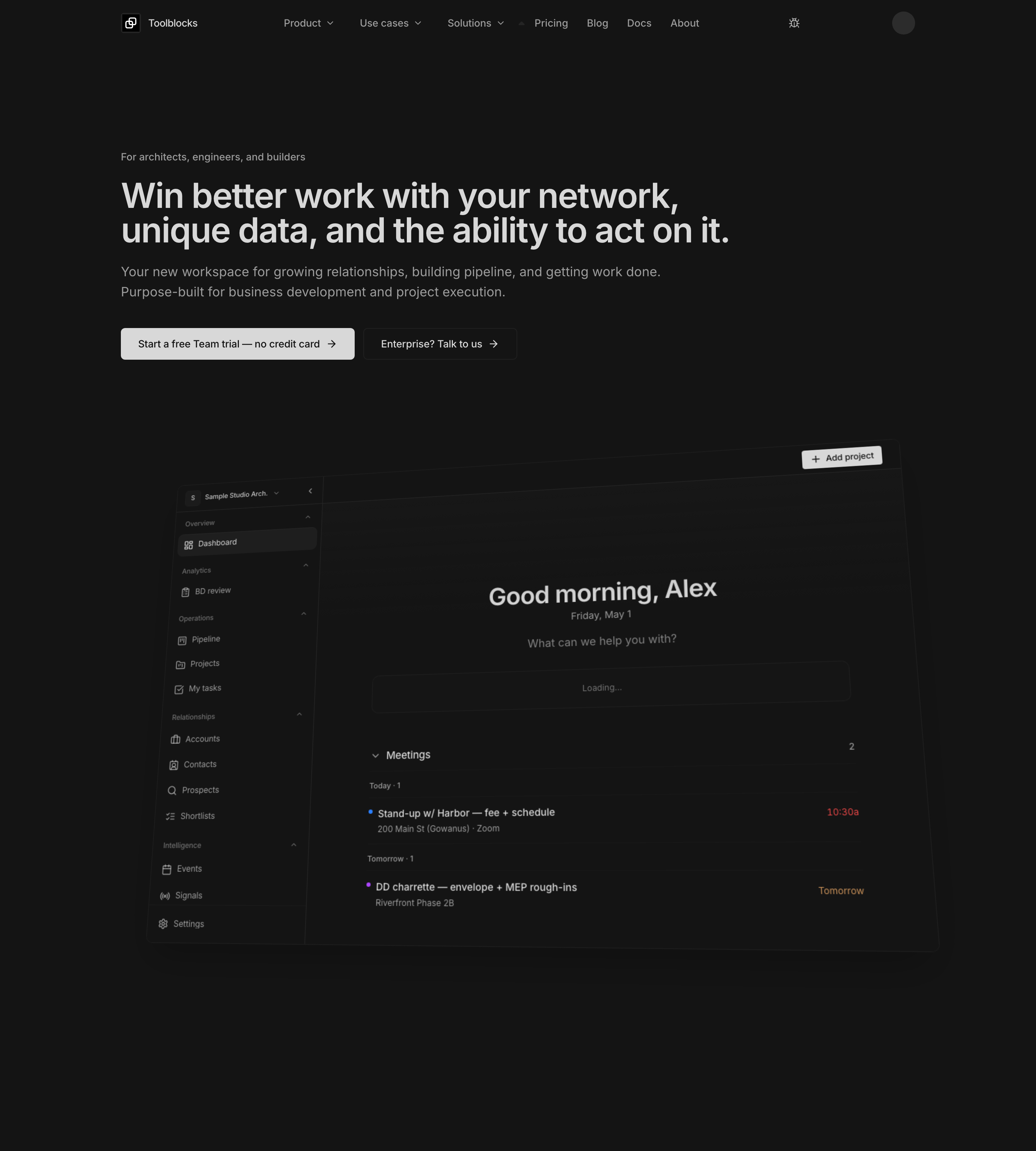
1. Toolblocks — best for specifier pursuit intelligence
Best for: Lighting design firms that need architect/owner/rep relationship memory, signals, meeting prep, and post-event follow-through.
- Relationship graph across architects, owners, reps, and collaborators.
- Evidence-backed account briefs with drafts for review.
- Best once follow-through after CEUs, trade shows, and architect intros needs to be shared across more than one principal, with next actions visible to the team.
- Limitation: Not photometric calculation, BIM, or rep quoting.
Lighting fit: Strong when work is won in specifier relationships and trade-show momentum—not only at bid.
Lighting design · Seller-doers · Business development · What is Toolblocks? · Pricing
2. HubSpot — best for marketing nurture and CEU lists
Best for: Specifier studios investing in content, CEU registration, and email campaigns.
- HubSpot pricing tiers for marketing hubs.
- Limitation: Weak for “who is our path into this architect’s next museum portfolio?” without customization.
Lighting fit: Marketing owns campaigns; principals need pursuit context elsewhere.
3. Monograph — best for hybrid design studios needing PM
Best for: Lighting practices that also run architecture-adjacent PM—time, projects, invoicing.
- Monograph’s public pricing page uses a firm-size calculator rather than a simple seat card; for smaller and mid-size firms, pricing commonly lands in the roughly $45-$60 per employee/month range, depending on employee count and billing selection—see Monograph pricing.
- Limitation: Specifier BD often stays outside Monograph.
Lighting fit: Hybrid studios more than rep agencies.
4. BQE CORE — best for PSA-minded lighting practices
Best for: Firms billing professional services with strong AR and utilization discipline.
- BQE does not publish a flat public entry price and says pricing varies by modules and user count—see BQE pricing overview.
- Limitation: BD not the product center.
Lighting fit: Growing specifier practices prioritizing billing.
5. Deltek / Cosential — best for AE-aligned marketing BD
Best for: Lighting groups on large institutional programs with formal marketing pursuits.
- Deltek ecosystem for capture and proposals.
- Limitation: Marketing-ops weight vs weekly specifier follow-up.
Lighting fit: Lighting paired with AE partners on marketed work.
6. Salesforce — best for enterprise capture
Best for: Larger specifier organizations with CRM admin and multi-office reporting.
- Salesforce’s public pricing page currently lists Starter Suite at $25/user/month and Pro Suite at $100/user/month—see Salesforce pricing.
- Many firms still treat it as the reporting database, while principal-level specifier follow-up happens elsewhere because Salesforce feels like data entry.
- Limitation: Implementation and hygiene cost.
Lighting fit: National specifier brands with BD staff—not typical 12-person studios.
7. Pipedrive — best for lightweight pipeline
Best for: One BD lead tracking a short list of architect and owner pursuits.
- Pipedrive’s pricing page currently lists Lite from US$14 per seat/month billed annually—see Pipedrive pricing.
- Limitation: No trade-show signal workflow or sourced briefs built in.
Lighting fit: Interim pipeline until specifier volume grows.
8. Zoho CRM — best for budget pipeline tracking
Best for: Cost-conscious teams maintaining records weekly.
- Zoho CRM pricing.
- Limitation: Customization for rep/architect/owner graph.
Lighting fit: First formal outreach system.
9. Harvest — best for time tracking with light client tracking
Best for: Studios that primarily need timesheets and invoices.
- Harvest pricing.
- Limitation: Peripheral CRM; not pursuit intelligence.
Lighting fit: Small specifier teams before BD system investment.
10. Spreadsheets — best until shared pursuit context breaks
Best for: Micro studios with discipline—or failure when three people need the same owner context before a presentation.
- Flexible but no signals or prep automation.
- Limitation: Post–Lightfair follow-up decay.
Lighting fit: Until 10+ people share pursuits.
Comparison at a glance
| Tool | Financial visibility | BD / pre-RFP | Typical firm size | Pricing (June 2026) |
|---|---|---|---|---|
| Toolblocks | Low (by design) | High | Shared specifier BD rhythm | Pricing |
| HubSpot | Low | Medium | Marketing-led | Free tools; Smart CRM Starter from $20/seat/month |
| Monograph | High | Low | Hybrid studio | Roughly $45-$60 per employee/month for many small-mid firms |
| BQE CORE | High | Low | PSA-minded | Quote-based |
| Deltek / Cosential | Medium–high | Medium | AE-aligned | Deltek quote |
| Salesforce | Low | Medium | Enterprise | Free Suite $0; Starter Suite $25/user/month |
| Pipedrive | Low | Low–medium | Small BD | Lite from US$14/seat/month billed annually |
| Zoho CRM | Low | Low–medium | Budget | Standard from $14/user/month annually |
| Harvest | Medium | Low | Small | Teams from $9/seat/month billed annually |
| Spreadsheets | Low | Low (manual) | Micro | — |
Pricing verified against vendor-owned pricing pages on June 3, 2026. Vendors can change pricing after publish.
Tools we did not include (and why)
| Tool | Role | Why not top 10 for design firms |
|---|---|---|
| Luxion, Parspec, Baucore | Rep quoting, crossing, agency CRM | Right category for rep agencies, not specifier BD |
| LumenBuilder | Lighting pro project mgmt | CRM-lite for projects—not architect pursuit intelligence |
| Photometric / BIM tools | Design delivery | Not BD |
| Manufacturer portals | Submittals and pricing | Logins are not a relationship system |
Common failure modes (and how to fix them)
Rep relationships not tied to pursuits.
Fix: Link rep firms and agents to active architect/owner pursuits with spec status.
Post–trade show follow-up decay.
Fix: 48-hour tasks with conversation context after Lightfair, LEDucation, or regional events.
Presentation prep from scratch.
Fix: Living owner/architect brief updated when portfolio or program news hits.
Confusing manufacturer portal logins with BD.
Fix: Keep portals for submittals; keep pursuit graph in a BD system.
Buying rep software as a design firm.
Fix: Match category to buyer—specifier vs agency.
FAQ
Do lighting design firms need CRM?
Once 10+ people share pursuits, you need shared architect/owner/rep context—not only personal inboxes and rep business cards.
CRM for lighting designer vs lighting rep agency?
Design firms need specifier pursuit intelligence (Toolblocks) plus optional HubSpot. Rep agencies need Parspec/Luxion/Baucore-class quoting and agency pipeline—see honesty block above.
Can Toolblocks support specifier-driven BD?
Yes—contacts, signals, prep, and follow-through for architect and owner relationships; complements Harvest, BQE, or HubSpot.
Is HubSpot enough alone for lighting designers?
HubSpot can run CEU and email. It will not surface “why now” for outreach or architect paths without customization and a weekly owner.
How do lighting firms track architect and rep relationships in one place?
Use a shared graph: firm, role, pursuit link, last touch, spec phase—not separate rep rolodex and personal email.
What software helps after Lightfair or LEDucation follow-up?
A pursuit system with dated next actions and meeting context—not a spreadsheet buried after install season.
Where does Toolblocks fit?
Pursuit intelligence for lighting design—alongside billing and marketing tools. See interior design CRM comparison for a parallel owner/architect frame.
Where to go next
Keep your billing and marketing stack. Add discipline for winning the next spec pursuit before fee proposal: lighting design, architects CRM list, pre-RFP BD, pricing.
About the author
George Valdes is the co-founder of Toolblocks. He previously led product as Head of Product at Integrated Projects (AI-powered Scan-to-BIM) and was Head of Marketing at Monograph. He co-founded Architechie NYC and serves as a board member for the 1735 NY Ave Investments Fund at the American Institute of Architects (AIA). He is based in St. Petersburg, Florida, and is bilingual in English and Spanish.