

Top 10 CRM options for civil engineering firms
CRM and ERP options for civil engineers—agency relationships, sub networks, and public pursuits vs Deltek, Unanet, and project accounting.
- CRM
- Civil engineering
- Business development
- Pre-RFP
- Competitive intelligence
By George Valdes, co-founder at Toolblocks.
Civil engineering work often flows through agencies, municipalities, GCs, and sub lists—with public calendars and relationship memory that lives in people's heads. Searching for the best CRM for civil engineers usually returns Unanet CRM for AEC, TrebleHook, and Monograph’s lead-tracking guide for A&E—or thin directories like SoftwareWorld—not long-form civil-specific listicles. That gap is why this guide exists.
This list names Deltek, Unanet, BQE, HubSpot, and others honestly, and shows where market and competitive intelligence belongs when financial visibility is already covered.
Related in this series: Architecture firms · Construction / precon · Structural engineering · Pre-RFP BD
Three layers civil firms actually need
| Layer | Purpose | Typical tools |
|---|---|---|
| Project financials | Cost, billing, compliance, WIP | Unanet, Deltek, BQE CORE |
| Pipeline CRM | Stages, proposals, marketing | HubSpot, Salesforce, Cosential |
| Pursuit intelligence | Agencies, subs, signals, prep | Toolblocks |
Winning a seat at the table before a public RFP posts is relationship and timing work—not something your ERP invoice module was built to orchestrate daily.
How we evaluated
For civil and site-development practices we weighted:
- Agency and owner relationship tracking (who owns the program, not only the project ID)
- Sub and partner network visibility for teaming
- Market intelligence—jurisdiction activity, competitor moves, public signals
- Meeting prep before precon and industry meetings
- Follow-through after conferences and shortlist conversations
- Integration path with Deltek, Unanet, HubSpot, or Airtable
- Low admin burden for principals who also manage technical work
We did not rank primarily on hydraulic modeling, CAD, or construction PM features.
Quick picks
Best for financial visibility and govcon-style accounting: Unanet or Deltek Vantagepoint.
Best for generic capture pipeline: Salesforce or HubSpot with strong admin.
Best for pre-RFP pursuit intelligence: Toolblocks for agency/subs, signals, sourced research, and follow-through—see civil engineering.
How to choose CRM for a civil engineering firm
Civil firm archetypes drive the stack: municipal-heavy (agency graphs, on-call pools, compliance), private land development (developer repeat work, faster cycles), and program / CM-led site civil (GC relationships, teaming subs at scale). Pick tools for your archetype first—not a generic “civil CRM” label.
-
Classify your book of business. Municipal program work, private land development, and GC-led site civil have different CRM needs—agency graphs vs developer repeat work vs hard-bid volume.
-
ERP first when cost is the crisis. If Unanet or Deltek is already the system of record, do not rip it for “CRM”—add pursuit intelligence for capture and prep.
-
Seller-doer test. Principals who will not log calls in Salesforce will not log them in Zoho. Prefer Outlook-native CRM (Unanet) or a lightweight pursuit workspace (Toolblocks).
-
Pre-RFP vs bid board. Public postings are late signal. Weight tools that support teasers, on-call pools, and relationship fit—not only opportunity stages after the job posts.
| Firm profile | Financial system | BD layer |
|---|---|---|
| Gov-heavy, 50+ staff | Unanet | Unanet CRM + Toolblocks for principal prep |
| Private site civil, 15–40 staff | BQE or Deltek | Toolblocks + optional HubSpot |
| Boutique land dev | Monograph or BQE | Toolblocks or Pipedrive until volume grows |
A weekly capture workflow for civil BD
- Scan signals (20 min): Council agendas, permit news, agency staff moves, GC awards in your geography—tie to watchlist accounts.
- Pursuit hygiene (20 min): Every active teaser/on-call has an owner, last touch, and next action.
- One brief (30 min): Sourced jurisdiction or account note before a precon or industry meeting—review facts, then outreach.
The list
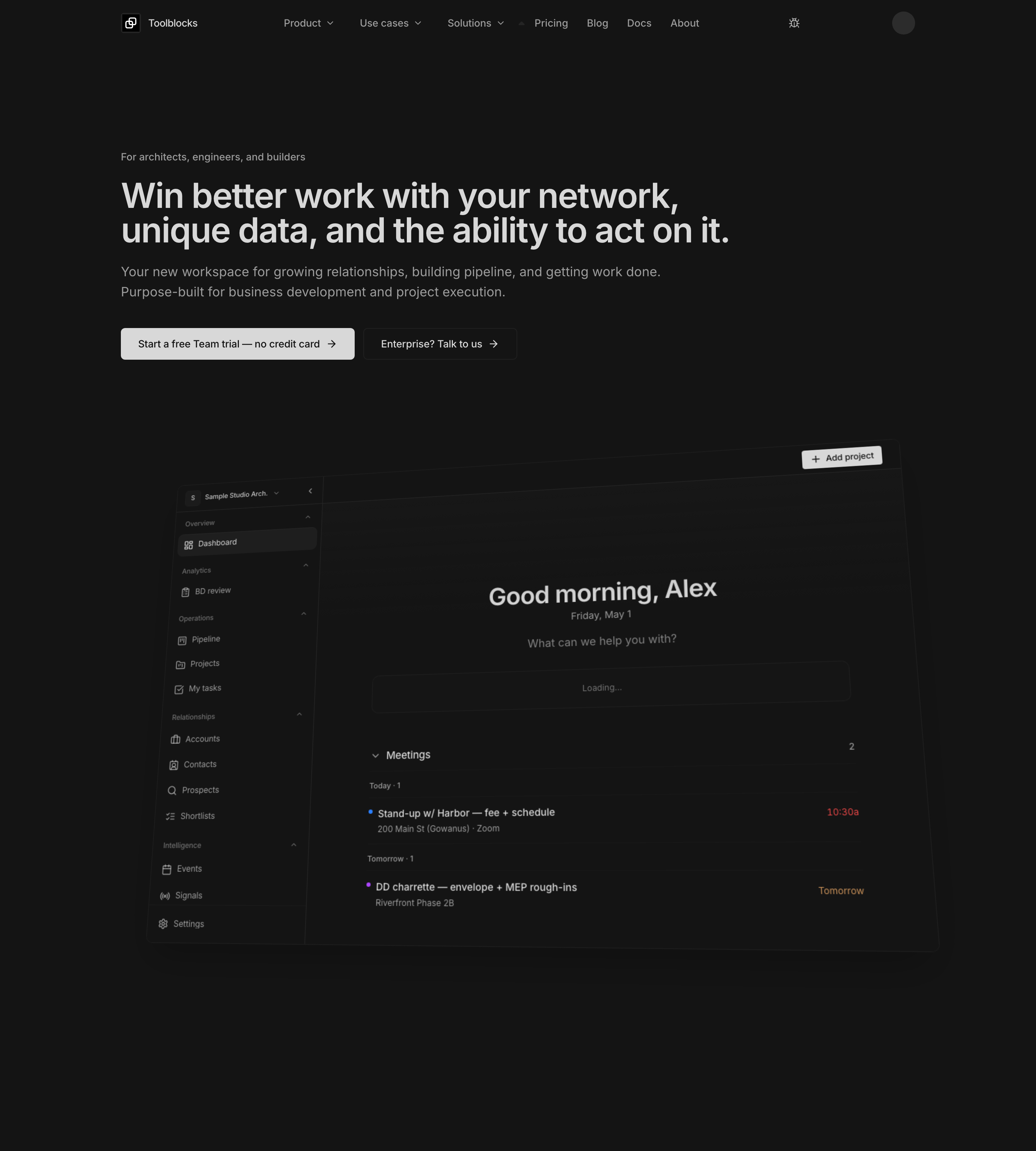
1. Toolblocks — best for agency and pursuit intelligence
Best for: Civil firms that need shared context on agencies, owners, GCs, and subs—with “why now” outreach and faster prep before pursuits formalize.
- Relationship graph across public and private sectors, not only opportunity records.
- Evidence-backed prospect and jurisdiction research with drafts for review.
- Event and meeting follow-through for seller-doer principals and BD leads, with next actions tracked in one place.
- Complements ERP while supporting pipeline tracking alongside Salesforce, Deltek, HubSpot, or Airtable.
- Limitation: Not project accounting, submittal tracking, or native invoicing.
Civil fit: Strong when you chase pre-RFP teasers, on-call pools, and repeat municipal clients—and need competitive intelligence without another enterprise rollout.
Civil engineering · Business development · What is Toolblocks? · Pricing
2. Unanet — best for project-based ERP and compliance
Best for: Civil and infrastructure orgs with heavy project accounting, especially gov-adjacent delivery.
- Deep project cost and compliance; quote-based pricing at unanet.com.
- Limitation: Capture and relationship rhythm often stay in email and spreadsheets unless you fund CRM modules and process.
Civil fit: Mid-to-large firms where Unanet is already the system of record for cost.
3. Deltek Vantagepoint — best for enterprise AEC/EPC pursuit reporting
Best for: Firms that need portfolio-level ERP and marketing CRM in one vendor story.
- Mature integrations and reporting for leadership.
- Limitation: Long implementations; daily principal BD may still need a lighter pursuit layer.
Civil fit: Regional infrastructure practices with dedicated capture and finance teams.
4. Cosential (Deltek) — best for formal pursuit and marketing CRM
Best for: Marketing BD teams tracking pursuits, proposals, and win strategies.
- AEC-native pursuit vocabulary.
- Limitation: Less suited to quick weekly seller-doer loops without marketing staff maintaining records.
Civil fit: When pursuits are formal and marketing ops owns the CRM hygiene.
5. Salesforce — best for capture teams with CRM admin
Best for: Civil firms with structured account plans, territories, and executive dashboards.
- Flexible for teaming partners and multi-office pipelines.
- Often strongest as the executive reporting layer, while seller-doers still resist using it as their day-to-day relationship workspace because it feels like data entry.
- Limitation: Expensive to configure for agency/sub graphs; principals won't maintain it alone.
Civil fit: Large infrastructure BD groups—not typical 20-person site civil shops.
6. HubSpot — best for marketing and inbound nurture
Best for: Firms publishing thought leadership and tracking inbound leads.
- Familiar automation; see HubSpot pricing.
- Limitation: Weak for public-agency relationship maps without customization.
Civil fit: When marketing runs the website and events; capture leads still need pursuit context.
7. BQE CORE — best for PSA, time, and billing
Best for: Civil practices billing like professional services with strong AR discipline.
- Time, expenses, and billing modules; BQE does not publish a flat public entry price and says pricing varies by modules and user count—see BQE pricing overview.
- Limitation: BD intelligence is not the core product story.
Civil fit: Private-sector site civil firms prioritizing utilization and billing over ERP.
8. Monograph — best for smaller design-adjacent studios
Best for: Boutique civil/design hybrids that want modern PM UX.
- Monograph’s public pricing page uses a firm-size calculator rather than a simple seat card; for smaller and mid-size firms, pricing commonly lands in the roughly $45-$60 per employee/month range, depending on employee count and billing selection—see Monograph pricing.
- Limitation: Less common for heavy public works ERP expectations.
Civil fit: Land development and small municipal practices more than billion-dollar JV programs.
9. Pipedrive — best for simple deal stages
Best for: A BD lead tracking a short list of private developments and GC relationships.
- Fast setup; Pipedrive’s pricing page currently lists Lite from US$14 per seat/month billed annually—see Pipedrive pricing.
- Limitation: No jurisdiction intelligence or sourced agency briefs out of the box.
Civil fit: Bridge tool before pursuit volume grows.
10. Zoho CRM — best for economical pipeline hygiene
Best for: Budget-conscious firms documenting pursuits and follow-up dates.
- Low entry price; verify Zoho CRM tiers.
- Limitation: Same customization tax for agency/sub/teaming models.
Civil fit: Early formalization of capture before ERP or pursuit intelligence investment.
Comparison at a glance
| Tool | Financial visibility | BD / pre-RFP | Typical firm size | Pricing (June 2026) |
|---|---|---|---|---|
| Toolblocks | Low (by design) | High | Shared capture / BD rhythm | Pricing |
| Unanet | High | Low | Gov / enterprise civil | Vendor quote |
| Deltek VP | High | Medium | Enterprise | Deltek quote |
| Cosential | Medium | Medium–high | Marketing BD | Deltek quote |
| Salesforce | Low | Medium | Large capture | Free Suite $0; Starter Suite $25/user/month |
| HubSpot | Low | Medium | Marketing-led | Free tools; Smart CRM Starter from $20/seat/month |
| BQE CORE | High | Low | PSA civil | Quote-based |
| Monograph | High | Low | Boutique | Roughly $45-$60 per employee/month for many small-mid firms |
| Pipedrive | Low | Low–medium | Small BD | Lite from US$14/seat/month billed annually |
| Zoho CRM | Low | Low–medium | Budget | Standard from $14/user/month annually |
Pricing verified against vendor-owned pricing pages on June 3, 2026. Vendors can change pricing after publish.
Tools we did not include (and why)
| Category | Examples | Why omitted from top 10 |
|---|---|---|
| Bid aggregators | Public plan rooms, bid boards | Find posted work; do not manage agency relationships |
| Civil design software | AutoCAD Civil 3D, Bentley | Delivery, not BD |
| Pre-RFP signal-only startups | Niche gov-data tools | Point solutions; compare on whether they feed a pursuit workflow you will actually run |
| Field-service platforms | Tools built for truck rolls | Wrong motion for site-civil design firms |
TrebleHook and HSO AEC360 belong in the same evaluation set as Cosential/Deltek for enterprise capture—not in a separate “generic CRM” bucket.
Common failure modes (and how to fix them)
ERP go-live without capture habits.
Fix: Keep Unanet/Deltek for money; add a pursuit layer for agency touch history and next steps—pre-RFP BD.
Agency relationships trapped with one principal.
Fix: Document program managers and deputies in a shared system before retirement or job change.
Chasing every public bid without relationship fit.
Fix: Use market intelligence to filter jurisdictions and clients where you have credibility, not only where a job posted today.
Sub teaming at the last minute.
Fix: Maintain a living sub/partner graph with last collaboration and discipline fit—not a static PDF from 2019.
Conference stack of business cards.
Fix: 48-hour follow-up tasks with context from the conversation, not generic LinkedIn connects.
FAQ
What CRM do civil engineering companies use?
Often Unanet or Deltek for project financials, plus HubSpot or Salesforce if marketing owns a pipeline—or spreadsheets until capture pain forces change. Pursuit intelligence (Toolblocks) fills the pre-RFP gap.
Deltek vs Unanet for civil firms?
Unanet is common in govcon-heavy project accounting. Deltek spans ERP and Cosential marketing CRM for larger AEC. Both excel at financial visibility; neither replaces weekly relationship and signal work for principals without added process.
How do civil firms get competitive intelligence?
Combine public sources (council agendas, permits, awards), project news, and relationship history into briefs principals can review—not ad hoc searches the night before a precon meeting. Toolblocks targets that workflow with sources.
Do small civil firms need CRM?
Once 10+ people share pursuits, spreadsheets break. You need shared agency context, owners, and next actions—even if ERP waits until later.
Can Toolblocks sit in front of Deltek or Unanet?
Yes. Toolblocks is positioned to complement Salesforce, Deltek, HubSpot, Airtable, and spreadsheet BD—handing off when a pursuit is formal enough for ERP opportunity objects. See FAQ in docs.
How much time does pursuit prep save?
Teams often reclaim hours per important meeting when account briefs and jurisdiction notes stay current—versus reconstructing threads from email and old proposals.
TrebleHook vs Unanet CRM for civil capture?
Unanet CRM (Cosential) is the long-standing AEC marketing CRM with Outlook pipeline and proposal workflows. TrebleHook is Salesforce-native pursuit management for firms already on Salesforce. Both are capture systems—not replacements for project accounting.
Should civil firms use HubSpot?
Use HubSpot when marketing owns inbound and events. Pair it with pursuit intelligence for agency relationships HubSpot will not model without heavy customization.
What CRM works for municipal on-call contracts?
You need program-level memory (agency contacts, past sub teams, evaluation criteria)—not only project IDs in ERP. Toolblocks complements ERP for that graph; Cosential/Unanet when marketing BD owns formal pursuits.
Is Monograph relevant for civil engineers?
For boutique land-development or design-adjacent civil studios, yes—for money and projects. For heavy public works ERP, Unanet/Deltek remain the norm—see architecture comparison.
Where to go next
Keep Deltek or Unanet for financial visibility. Invest in winning work before the RFP with agency-aware pursuit intelligence: civil engineering, Win work overview, pricing, and Top 10 CRM for architects for a parallel comparison frame.
About the author
George Valdes is the co-founder of Toolblocks. He previously led product as Head of Product at Integrated Projects (AI-powered Scan-to-BIM) and was Head of Marketing at Monograph. He co-founded Architechie NYC and serves as a board member for the 1735 NY Ave Investments Fund at the American Institute of Architects (AIA). He is based in St. Petersburg, Florida, and is bilingual in English and Spanish.